

Trump Presses Fed for World's Lowest Rate Ahead of FOMC
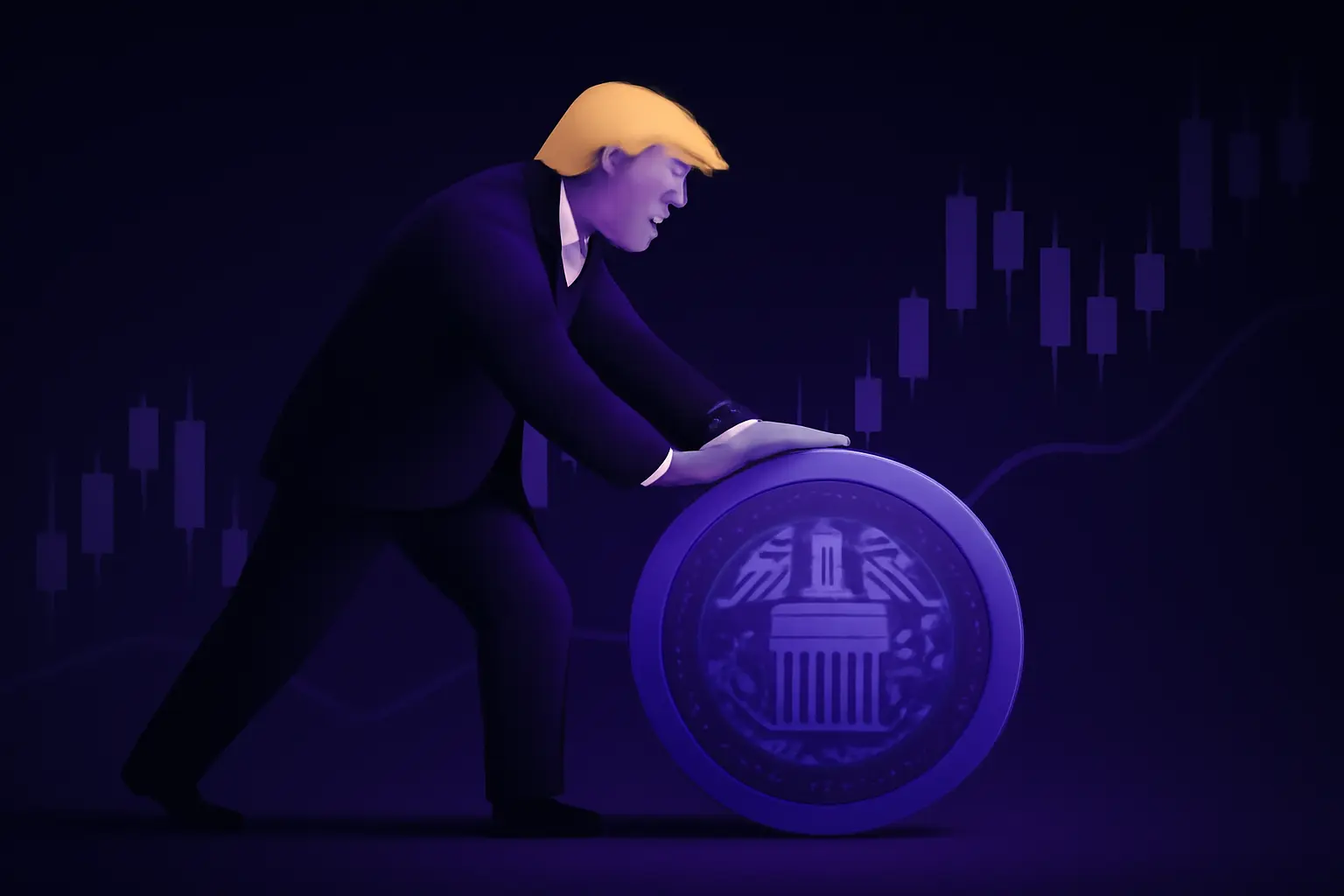
President Trump says the US should have the world's lowest interest rate, ramping up pressure on the Fed just before its policy meeting. Markets weigh the political heat against data.
Fed pause / no change
Typical directional bias by asset when this plays out — from the VNIX macro impact model. Educational, not financial advice.
VNIX Quick Take
- President Trump publicly calls for the US to have the world's lowest interest rate, directly pressuring the Federal Reserve ahead of its upcoming meeting.
- The remarks revive the debate over central bank independence and whether political pressure can shift the rate path.
- Traders will watch the Fed's statement and dot plot for any sign that the political noise is bleeding into policy decisions.
Trump's Push for the World's Lowest Rate Hits the Fed's Radar
Just days before the Federal Open Market Committee (FOMC) is set to gather, President Donald Trump said the United States should have the lowest interest rate in the world. The comment, made ahead of the Fed's meeting, injects a fresh layer of political tension into an already delicate policy environment. It is not the first time Trump has called for lower rates, but the timing — right before the FOMC decision — amplifies its market relevance.
The Fed's benchmark rate currently sits in a range that is well above those of many other major economies, including the eurozone and Japan. That gap has been a recurring theme in Trump's criticism, as he argues that higher US rates put American exporters and borrowers at a disadvantage. The Fed, however, operates under a dual mandate of maximum employment and price stability, and its officials have repeatedly stressed that policy decisions are based on data, not political preferences.
Investors are now left to parse whether the President's comments will have any tangible effect on the FOMC's deliberations. Historically, the Fed has guarded its independence fiercely, and public pressure from the White House has rarely altered the immediate policy path. Yet the mere mention of the world's lowest rate — a theoretical race to the bottom — raises questions about the dollar, bond yields, and risk assets in the days surrounding the meeting.
Why the Fed's Rate Path Is a Political Lightning Rod
Trump's Long-Running Campaign for Cheap Money
Trump has consistently advocated for lower interest rates, arguing that they would boost economic growth and reduce the government's borrowing costs. His latest remark that the US should have the world's lowest rate echoes that stance but goes further, framing the issue as a global competitiveness matter. The President has previously suggested that the Fed should cut rates even when the economy appears strong, a view that clashes with the central bank's cautious, data-dependent approach.
This public pressure comes as the Fed weighs whether to adjust policy amid mixed economic signals. Inflation has moderated from its peak but remains above the Fed's 2% target, while the labor market has shown resilience. Fed Chair Jerome Powell has emphasized that the committee will act independently and base its decisions on incoming data. Still, the political spotlight adds a layer of complexity for traders trying to anticipate the Fed's next move.
Central Bank Independence Under the Microscope
The principle of central bank independence is central to how the Fed operates. By insulating monetary policy from short-term political cycles, the Fed aims to make credible, long-term decisions that anchor inflation expectations. When politicians publicly pressure the Fed, markets may start to question whether that independence is being eroded, potentially leading to higher risk premiums on US assets.
However, the Fed's structure — including staggered terms for governors and the ability of policymakers to dissent — provides some protection against direct political influence. Many economists argue that the Fed's credibility is its most valuable asset, and Powell has repeatedly said the central bank will not be swayed by political considerations. Traders should monitor whether any FOMC members acknowledge the political pressure in their statements, as that could be a subtle signal of shifting dynamics.
Key Levels and Assets to Watch as the FOMC Meets
As the Fed meeting approaches, market participants will focus on several key indicators. The US 10-year Treasury yield is a critical gauge of rate expectations; a spike above 4.8% could signal that markets are pricing in a more hawkish Fed, while a sharp drop might indicate dovish sentiment. The dollar index (DXY) will also be in focus, as lower rates typically weaken the greenback, making US exports more competitive but potentially stoking imported inflation.
For traders, the FOMC statement, updated economic projections (including the dot plot), and Powell's press conference are the main events. Any deviation from expectations — whether a surprise rate cut, a hawkish hold, or a signal of future easing — could trigger volatility across major assets. Gold, which often moves inversely to real yields, could see sharp swings, while equity markets may react to the perceived growth implications. It's also worth watching the euro and yen, as the interest rate differential with the US is a key driver of currency pairs.
How Traders Can Navigate the Political Noise Around the Fed
Political commentary can create short-term noise, but it rarely changes the fundamental trajectory of monetary policy. Traders should separate rhetoric from actionable data. The Fed's decisions are driven by employment, inflation, and financial conditions — not by presidential tweets. That said, if political pressure begins to influence market expectations, it can become a self-fulfilling prophecy, especially if investors start pricing in a more dovish Fed than the data warrants.
One approach is to focus on the Fed's reaction function: what would it take for the committee to cut rates? A sustained decline in inflation toward 2%, a weakening labor market, or a sharp tightening of financial conditions could prompt action. Conversely, if inflation remains sticky, the Fed may hold steady regardless of political calls. Using tools like the CME FedWatch Tool can help gauge market-implied probabilities of rate moves, offering a reality check against the political narrative.
Risk management is crucial around FOMC meetings, as volatility often spikes. Position sizing, stop-loss orders, and diversification can help mitigate unexpected swings. For those looking to trade the event, understanding the Fed's communication style and the market's positioning ahead of time is essential. It's also wise to consider the broader context: the Fed is not acting in a vacuum, and global central banks — from the ECB to the BOJ — are making their own policy choices. A coordinated easing cycle could weaken the dollar broadly, while divergent policies might create relative value opportunities in forex pairs.
Finally, remember that the Fed's independence is a double-edged sword. While it prevents short-term political meddling, it also means the Fed can disappoint markets if it sticks to its mandate. Traders should be prepared for either outcome: a Fed that acknowledges political pressure and adjusts its tone, or one that doubles down on data dependence and ignores the noise. In either case, the reaction in bonds, currencies, and equities will provide the clearest signal of what comes next.
In VNIX's view
Trump's call for the world's lowest interest rate is unlikely to change the Fed's immediate decision, but it adds a layer of political risk that traders cannot ignore. The Fed's credibility hinges on appearing independent, so any hint of yielding to pressure could unsettle markets. For now, focus on the data and the dot plot — they will speak louder than any political soundbite.
Educational analysis, not financial advice. Trading involves risk.
Trade smarter with VNIX indicators
Clear entry, exit and risk signals right on your TradingView chart.