

Lagarde's ECB Era Nears Its End: What Leadership Change Means for Markets
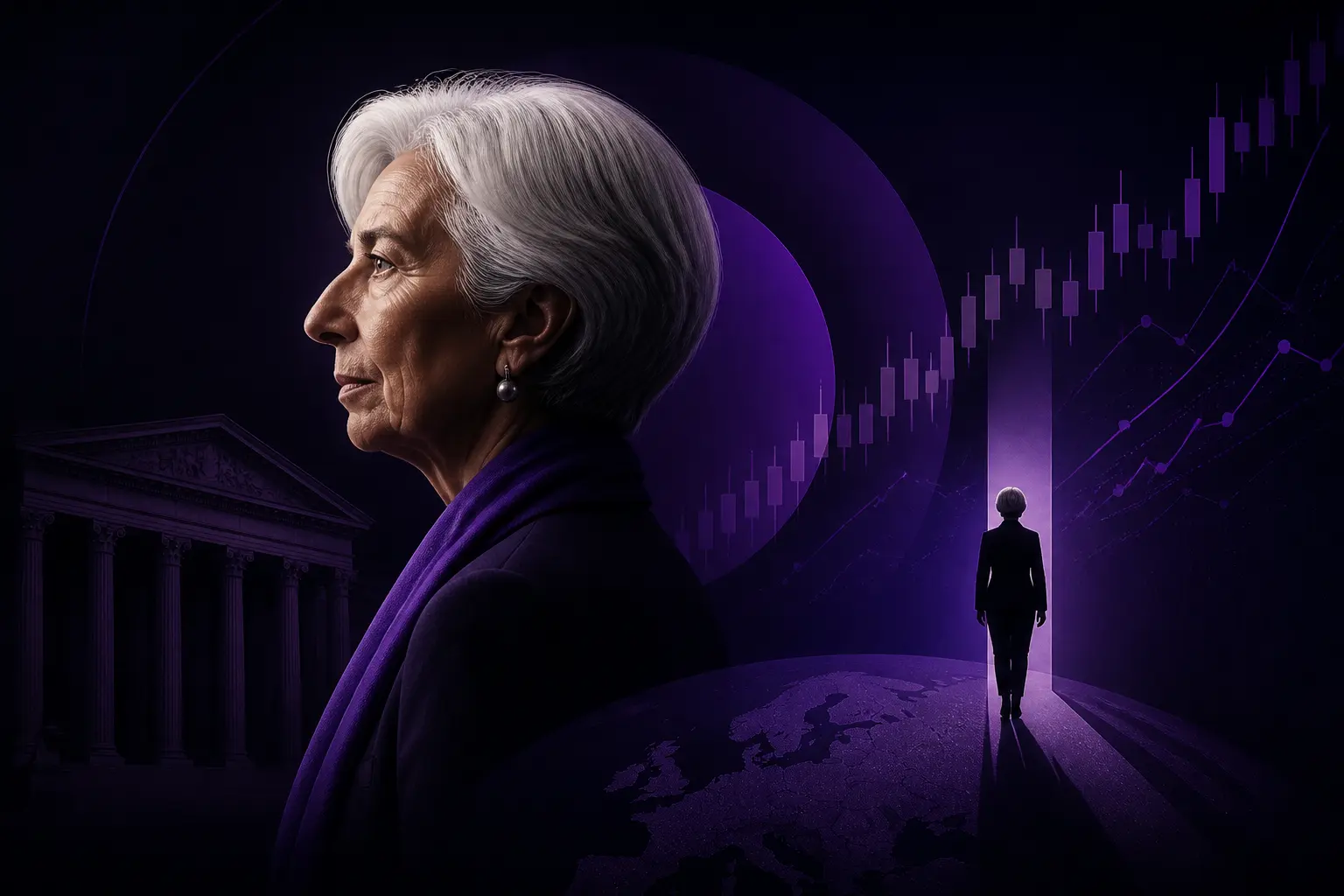
Christine Lagarde's long tenure at the helm of the European Central Bank is drawing to a close. Here's what a leadership transition could mean for euro traders.
VNIX Quick Take
- Christine Lagarde's extended stay as ECB President is reportedly reaching its conclusion, opening the question of who steers euro-area monetary policy next.
- Leadership transitions at major central banks inject uncertainty into rate expectations — the primary fuel for EUR/USD and euro-area bond pricing.
- Traders should watch the succession process, not just the person, since the incoming chief's policy leanings will shape the euro's medium-term direction.
Lagarde's Long ECB Chapter Is Finally Drawing to a Close
Christine Lagarde, who took over the European Central Bank presidency in late 2019 after a decade running the International Monetary Fund, is reportedly nearing the end of her extended tenure at the institution. Her time in office has spanned an unusually turbulent stretch for the euro area — from the pandemic emergency that triggered massive bond purchases, through the fastest inflation spike in the currency bloc's history, to the subsequent tightening cycle that pulled rates up sharply from negative territory.
The headline framing of a "long goodbye" reflects the reality that Lagarde's departure has been anticipated for some time, with her term having already been stretched relative to initial expectations. For markets, the key question is not the farewell itself but what comes next: who inherits the policy framework, and how that person's instincts differ from Lagarde's consensus-building, communication-heavy style.
Euro-area monetary policy sits at a delicate juncture. Inflation has cooled substantially from its peak, but services prices and wage growth remain sticky enough that the ECB has been reluctant to declare victory. Any leadership change at this moment carries outsized weight because the next president will inherit a still-unresolved debate over how fast to ease policy.
Why a Changing of the Guard at the ECB Moves the Euro
Succession Risk Premium and the EUR/USD Reaction Function
Central bank leadership transitions are rarely priced cleanly in advance. Markets tend to assign a "succession risk premium" — a small but persistent discount or premium baked into the currency and rate expectations — until the incoming chief's reaction function becomes clear. For the euro, that means EUR/USD could see choppy, headline-driven trading as candidate names surface and their past statements get scrutinized.
The mechanism is straightforward: if the likely successor is perceived as more hawkish — prioritizing inflation control over growth support — euro-area rate expectations rise and the currency typically firms. If the successor is seen as more dovish, favoring faster cuts or a looser stance, the euro tends to soften. The market's job is to read the signals early; the trader's job is to recognize that these repricings often happen on rumor before they are confirmed on fact.
The Policy Framework Itself Is in Play
Beyond personality, the transition raises questions about the ECB's operating framework. The euro area has grappled with how to handle fragmentation risk between core and periphery sovereign spreads, how to communicate forward guidance, and how aggressively to use balance-sheet tools. A new president could shift the emphasis among these priorities.
For traders, this matters because framework changes alter the correlation between euro-area government bonds and the currency. During Lagarde's tenure, the ECB's anti-fragmentation tooling helped anchor peripheral spreads; whether that anchor holds under new leadership is a structural question that could influence spread and volatility indicators for months. Watching how the succession debate touches on these tools is more informative than tracking the personalities alone.
Levels and Signals to Watch Through the Transition
The most direct barometer will be euro-area rate expectations, typically read through forward-dated swaps and the pricing of future ECB meetings. If markets begin to price a different terminal rate path as succession news develops, that repricing will show up first in short-dated yields and then filter into the currency. Watch whether the spread between German and Italian yields stays contained — a widening would suggest the market is questioning the continuity of the ECB's backstop.
On the currency side, EUR/USD behavior around its recent ranges and the euro's crosses against the yen and pound will reveal whether traders are treating the transition as a genuine regime shift or a non-event. Volatility measures for the euro are worth monitoring; a sustained rise in implied volatility would signal that options markets are pricing elevated uncertainty around the handover. None of this is a trade signal in itself — it is context for framing risk.
How Traders Should Frame a Central Bank Handover
First, separate the process from the outcome. The nomination and confirmation process generates headlines, speculation, and short-term noise; the actual policy stance of the new president takes months to reveal itself. Traders who confuse the two often overreact to the noise and underreact to the substance. A disciplined approach treats the process as a source of volatility and the outcome as a source of trend.
Second, remember that central bank leadership changes rarely produce immediate policy pivots. Institutional continuity at the ECB is strong — the Governing Council is a committee, and the president is one voice among many, albeit a decisive one in setting the tone. The market's initial read on a successor is frequently revised once that person actually chairs meetings. This is why experienced traders keep position sizing modest around transition headlines and wait for confirmation from actual policy communication.
Third, use the transition as a prompt to review your exposure to euro-area assets broadly — not just the currency. Euro-area equities, peripheral bonds, and rate-sensitive sectors all carry some sensitivity to the ECB's stance. If you are newer to macro trading, our classroom resources and trader-style quiz can help you map which instruments fit your approach before you take on transition-related risk. And if you plan to act on any of this, you will need a broker account set up in advance so execution is not a bottleneck when volatility arrives.
Finally, keep an eye on how the broader macro backdrop interacts with the handover. If inflation continues to cool and growth holds up, the next president inherits a relatively benign environment — which reduces the market impact of the transition. If inflation proves sticky or growth falters, the succession becomes a much higher-stakes event, and the euro's reaction function could shift quickly. Sharing observations with other traders in our signal rooms can help you pressure-test your read as the story develops.
In VNIX's view
The end of Lagarde's ECB tenure is a slow-burning story rather than a sharp catalyst, but it matters because it introduces a new variable into euro rate expectations at a moment when the easing path is still unsettled. The market will likely trade the succession narrative in fits and starts, with the biggest moves coming when a clear frontrunner emerges or when the incoming chief's first policy signals land. Until then, treat transition headlines as volatility to manage, not a directional thesis to chase.
Educational analysis, not financial advice. Trading involves risk.
Get real-time trade signals
Entry, target and stop-loss for gold, crypto and forex — curated by our team.