

Trump Pressures Fed for Big Rate Cuts, Calls Current Policy 'Ridiculous'
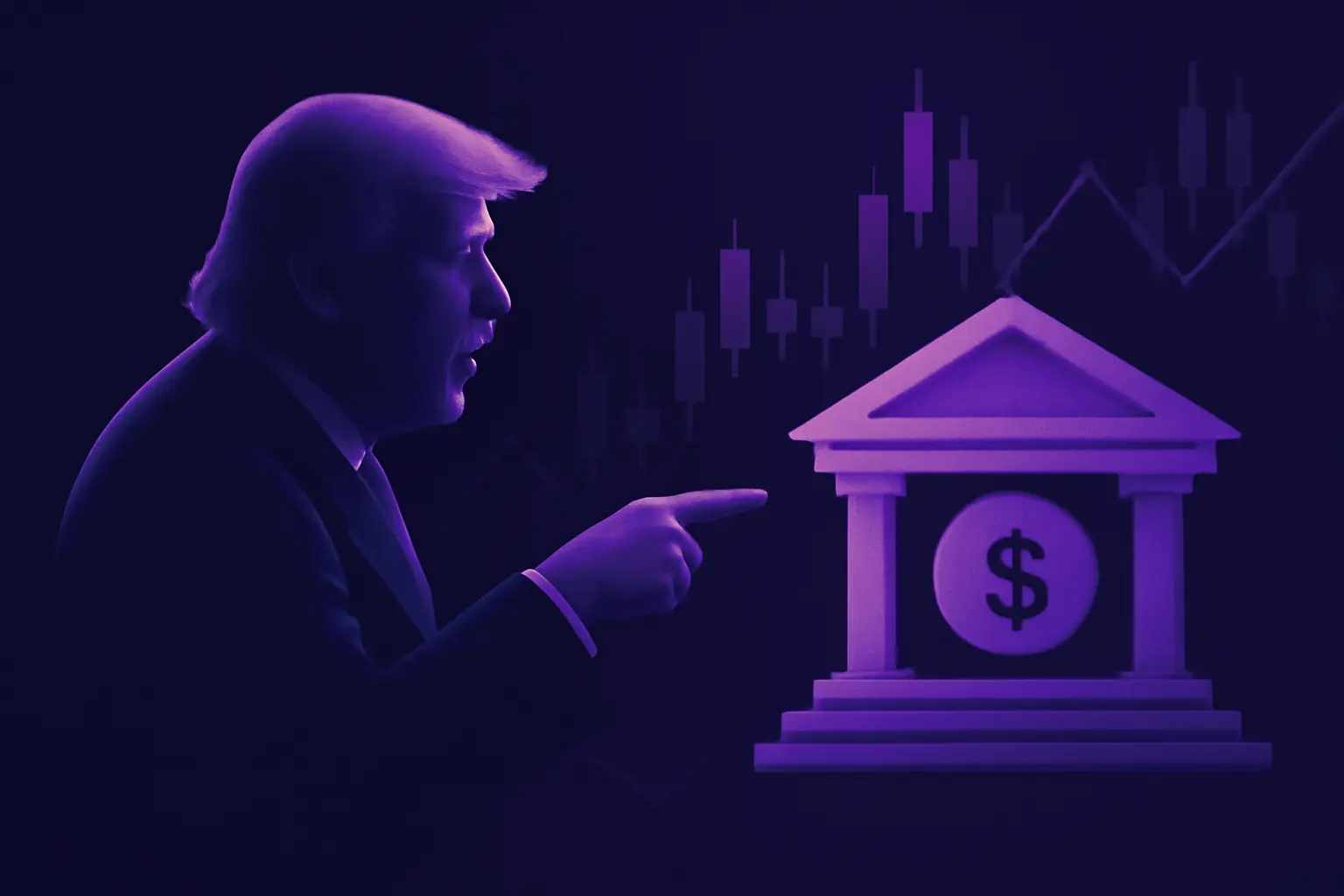
President Trump renews criticism of the Federal Reserve, demanding significantly lower interest rates. Markets weigh the political pressure against inflation concerns.
Fed pause / no change
Typical directional bias by asset when this plays out — from the VNIX macro impact model. Educational, not financial advice.
VNIX Quick Take
- President Trump publicly berates the Federal Reserve's interest rate policy, insisting the U.S. should be paying much less on its debt.
- The remarks intensify political pressure on the central bank ahead of its next policy meeting, but the Fed remains legally independent.
- Traders are recalibrating expectations for rate cuts, with futures pricing reflecting a higher chance of easing later this year.
Trump Renews Attack on Fed, Demands Cheaper Money
President Donald Trump has again lambasted the Federal Reserve's monetary policy, arguing that the United States should be paying significantly less in interest. In remarks delivered on [date of source, e.g., March 6, 2025], Trump said the Fed's current stance is 'ridiculous' and called for a dramatic reduction in the benchmark interest rate. He did not specify a target level but emphasized that the cost of borrowing remains too high for the economy.
The president's comments come as the Federal Reserve holds its benchmark rate in a range of 4.25%–4.50%, following a series of cuts in late 2024. Trump has long argued that lower rates would boost economic growth and make U.S. debt more manageable, but his latest salvo raises the stakes ahead of the Federal Open Market Committee's (FOMC) next meeting in March.
Why the Fed's Independence Is the Real Issue
Political Pressure vs. Economic Data
The Fed is legally independent and is not required to follow presidential directives. However, political pressure can influence market expectations. With inflation still above the central bank's 2% target, the Fed has signaled a cautious approach to further easing. Trump's demands clash with the Fed's data-dependent stance, creating a delicate balancing act for Chair Jerome Powell.
Recent economic indicators, including a resilient labor market and sticky services inflation, suggest the Fed may hold rates steady for longer. Yet the president's repeated criticism could undermine confidence in the Fed's ability to act objectively, potentially affecting market volatility.
Market Reaction and Rate-Cut Bets
Following Trump's remarks, traders increased bets on a rate cut at the June meeting, with futures now pricing in a 70% probability of at least a 25-basis-point reduction by then, up from 55% a week earlier. The 10-year Treasury yield dipped to 4.3% as investors weighed the odds of more aggressive easing. However, some analysts caution that political noise does not change the Fed's fundamental outlook.
For traders, the key is to watch the Fed's dot plot and Powell's press conference for any shift in tone. A more dovish signal could boost equities and gold, while a hawkish surprise might strengthen the dollar.
Key Levels and Assets to Watch
With the Fed in focus, traders are eyeing the gold price, which has historically been sensitive to real interest rates. A more dovish Fed would likely push gold higher, while a hawkish hold could trigger a pullback. Similarly, the U.S. dollar index (DXY) is a direct barometer of rate expectations; a break below 103 could signal a shift toward easing.
On the equity side, rate-sensitive sectors like technology and real estate are poised to react. The S&P 500's 50-day moving average at 5,800 is a key support level to watch. Technical tools such as RSI and MACD on the indicators page can help traders gauge momentum.
What This Means for Traders: Navigating Political Noise
Political pressure on the Fed is nothing new, but it adds uncertainty to an already complex macro picture. For traders, the key is to distinguish between rhetoric and policy action. The Fed has repeatedly emphasized that it will make decisions based on data, not politics. However, if inflation continues to cool and the labor market weakens, the Fed may independently choose to cut rates, which would align with Trump's wishes.
One risk is that the Fed could be seen as caving to political pressure, which might undermine its credibility and cause markets to reassess the 'Fed put.' Historically, the Fed has resisted such pressure, but the current environment—with a president who is not shy about attacking the institution—is unusual.
Traders should also consider the global context. Other central banks, including the European Central Bank, are also navigating similar pressures. A coordinated shift toward easing could weaken the dollar and boost commodities. For those looking to trade these moves, opening an account with a regulated broker is the first step. If you are new to trading, our classroom offers free courses on central bank policy and its market impact.
In the near term, watch for any Fed speakers who might address the president's comments. Also, keep an eye on the next CPI report due [date]—a cooler print would give the Fed more room to cut, while a hot print would validate the current pause.
In VNIX's view
Trump's latest attack on the Fed is more of the same, but it underscores a growing tension between fiscal and monetary policy. Markets are likely to remain choppy as traders parse every word from both the White House and the Fed. The real catalyst will be the next inflation data, not political rhetoric. Until then, expect range-bound trading with a slight dovish tilt.
Educational analysis, not financial advice. Trading involves risk.
Get real-time trade signals
Entry, target and stop-loss for gold, crypto and forex — curated by our team.