

Fed Decision Ripples: What It Means for Savings, Loans, Cards and Portfolios
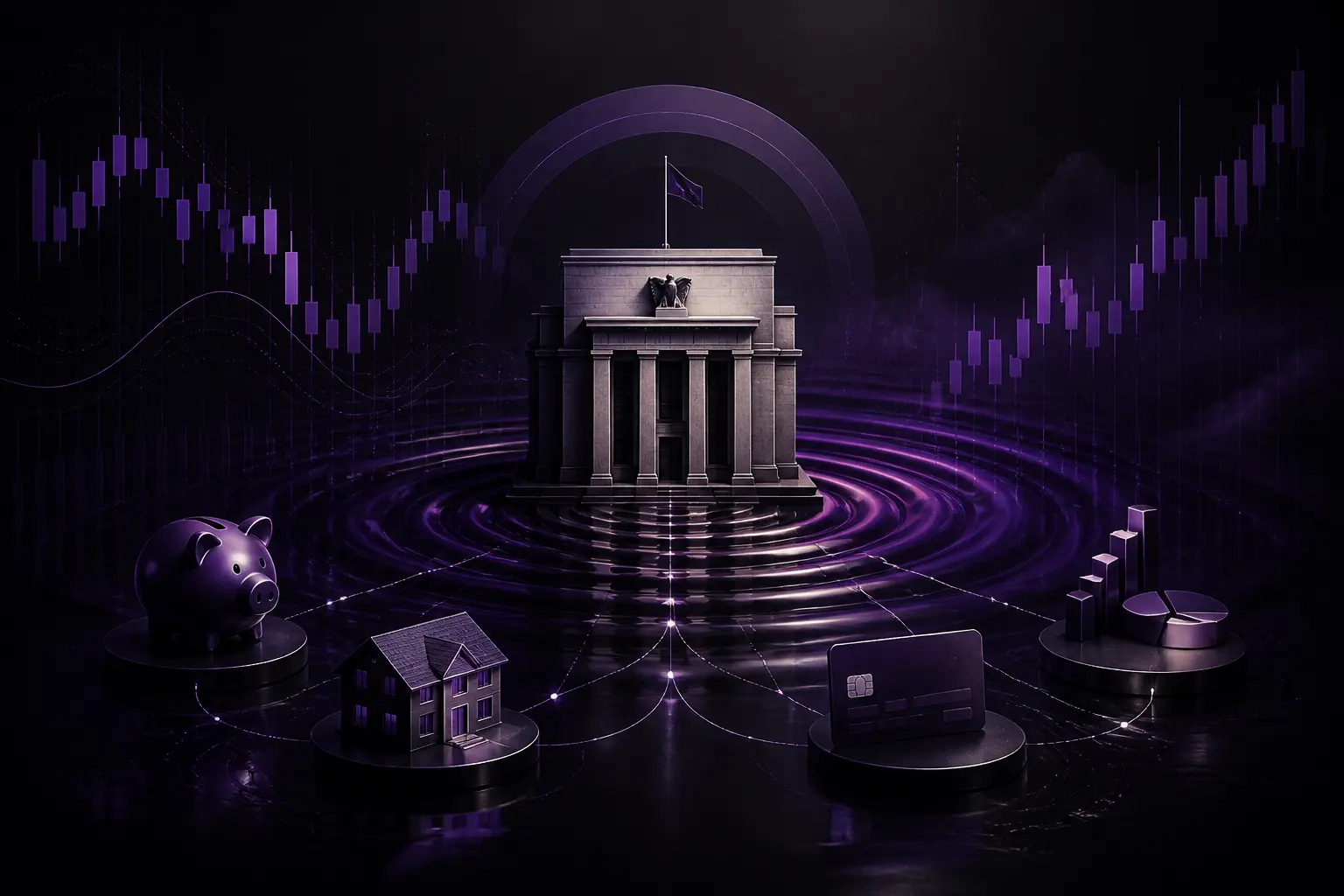
The Fed's latest rate decision affects deposit yields, borrowing costs, credit card APRs and investment returns. Here's a trader-focused breakdown.
Fed pause / no change
Typical directional bias by asset when this plays out — from the VNIX macro impact model. Educational, not financial advice.
VNIX Quick Take
- The Fed's rate decision sets the benchmark that filters through to savings rates, loan pricing, credit card APRs and asset valuations.
- Deposit yields and borrowing costs rarely move in lockstep — the spread between them is where consumer and trader outcomes diverge.
- Markets price the decision instantly, but the real transmission to household and corporate balance sheets unfolds over weeks and months.
Fed Rate Decision: The Benchmark That Touches Every Balance Sheet
The Federal Reserve's latest interest rate decision is the single most consequential number for anyone holding cash, carrying debt or owning financial assets. The federal funds rate — the rate banks charge each other for overnight reserves — serves as the anchor for virtually every other interest rate in the economy, from the yield on a savings account to the APR on a credit card.
When the Fed adjusts this benchmark, the effects radiate outward through several distinct channels. Deposit rates at banks tend to follow the policy rate fairly closely, though often with a lag and with varying degrees of generosity depending on the institution. Loan rates — particularly short-term products like variable-rate credit cards and home equity lines — are typically quick to reprice. Longer-term borrowing costs, such as 30-year mortgages, are influenced more by market expectations about future policy than by the current rate itself.
For traders, the decision matters because it changes the discount rate applied to future cash flows across every asset class. Equities, bonds, currencies and commodities all respond to shifts in the perceived path of policy. The immediate market reaction is often about the gap between what was expected and what was delivered — not the absolute level of rates. Understanding this distinction is essential for interpreting post-decision volatility.
Why Deposit Yields and Loan Costs Diverge After a Fed Move
The Pass-Through Gap Between Policy and Your Savings Account
Banks do not automatically pass the full policy rate change to depositors. When the Fed raises rates, lenders often boost loan pricing quickly while being slower to increase savings yields — a dynamic that widens net interest margins. Conversely, when the Fed cuts, deposit rates can fall faster than loan rates, preserving bank profitability at the expense of savers. This asymmetry means the effective yield on cash is not simply the Fed funds rate minus a constant; it depends on competitive dynamics, bank funding needs and the broader rate environment.
For traders monitoring interest-rate-sensitive assets, this gap is a useful signal. A widening spread between what banks earn on loans and pay on deposits can support bank equity valuations, while a narrowing spread may signal pressure on margins. Watching deposit rate trends alongside policy decisions provides a more complete picture than the headline Fed number alone.
Credit Cards and Variable Loans: The Fastest Transmission Channel
Variable-rate debt reprices almost immediately after a Fed move. Credit card APRs, home equity lines of credit and many small business loans are typically tied to the prime rate, which moves in near lockstep with the federal funds rate. For households carrying balances, a rate increase raises the cost of servicing that debt within one or two billing cycles — a direct and rapid transmission mechanism that can influence consumer spending patterns.
This rapid pass-through has macroeconomic implications. Higher debt service costs reduce disposable income, which can weigh on consumption — a key component of GDP. Traders watching economic indicators should consider how household debt burdens might amplify or dampen the impact of Fed policy on broader growth. The faster this channel works, the more quickly policy changes feed into real economic activity.
Key Levels and Assets to Watch Around the Fed Decision
The most immediate market barometer is the US 10-year Treasury yield, which reflects both the current policy rate and expectations for future inflation and growth. A sharp move above or below recent ranges can signal a shift in the market's policy outlook. The 2-year yield is even more sensitive to near-term Fed expectations and often leads the 10-year in responding to policy surprises. For currency traders, the US dollar index and major pairs like EUR/USD and USD/JPY react to the perceived divergence between the Fed and other central banks.
Equity markets, particularly rate-sensitive sectors such as technology and real estate, respond to changes in the discount rate. Gold, which pays no yield, often moves inversely to real interest rates — making it a useful gauge of how the market is interpreting the Fed's stance. Traders can track these relationships in real time through live price data and use technical indicators to assess momentum and overbought or oversold conditions following the announcement.
How Traders Can Think About the Fed's Impact on Portfolios
Beyond the immediate reaction, the Fed decision shapes the opportunity set across asset classes. A higher-for-longer rate environment tends to favor cash and short-duration bonds while pressuring long-duration growth equities and rate-sensitive sectors. A dovish pivot can reverse these dynamics, benefiting duration-sensitive assets and weakening the dollar. The key for traders is to distinguish between the policy decision itself and the market's interpretation of the future path — the latter often drives more significant moves.
Risk management becomes especially important around Fed announcements because volatility can spike sharply in both directions. Position sizing, stop-loss placement and awareness of upcoming economic data — such as the next non-farm payrolls or CPI release — are critical. Traders should also consider how their existing positions correlate with rate expectations; a portfolio concentrated in rate-sensitive assets may need adjustment to manage event risk. Engaging with a community of traders in signal rooms can provide diverse perspectives on how others are positioning around the decision.
For those newer to trading, understanding the Fed's role is foundational. The classroom offers resources on how central bank policy interacts with market structure, and the trading style quiz can help identify whether a macro-driven approach aligns with your risk tolerance and time horizon. Before executing any trades based on Fed-related analysis, ensure you have access to a broker account with appropriate risk controls.
In VNIX's view
The Fed's rate decision is not a single event but a catalyst that works through multiple channels with varying speeds and intensities. Savers and borrowers experience it through the spread between deposit and loan rates, while traders see it reflected in asset prices and volatility. The most robust approach is to focus on the gap between market expectations and the actual decision, then monitor how that gap closes over subsequent sessions.
Educational analysis, not financial advice. Trading involves risk.
Not sure which tool fits you?
Take the 2-minute quiz and get a personalized recommendation.