

France, Germany Take Key ECB Roles as Spain Set for Presidency
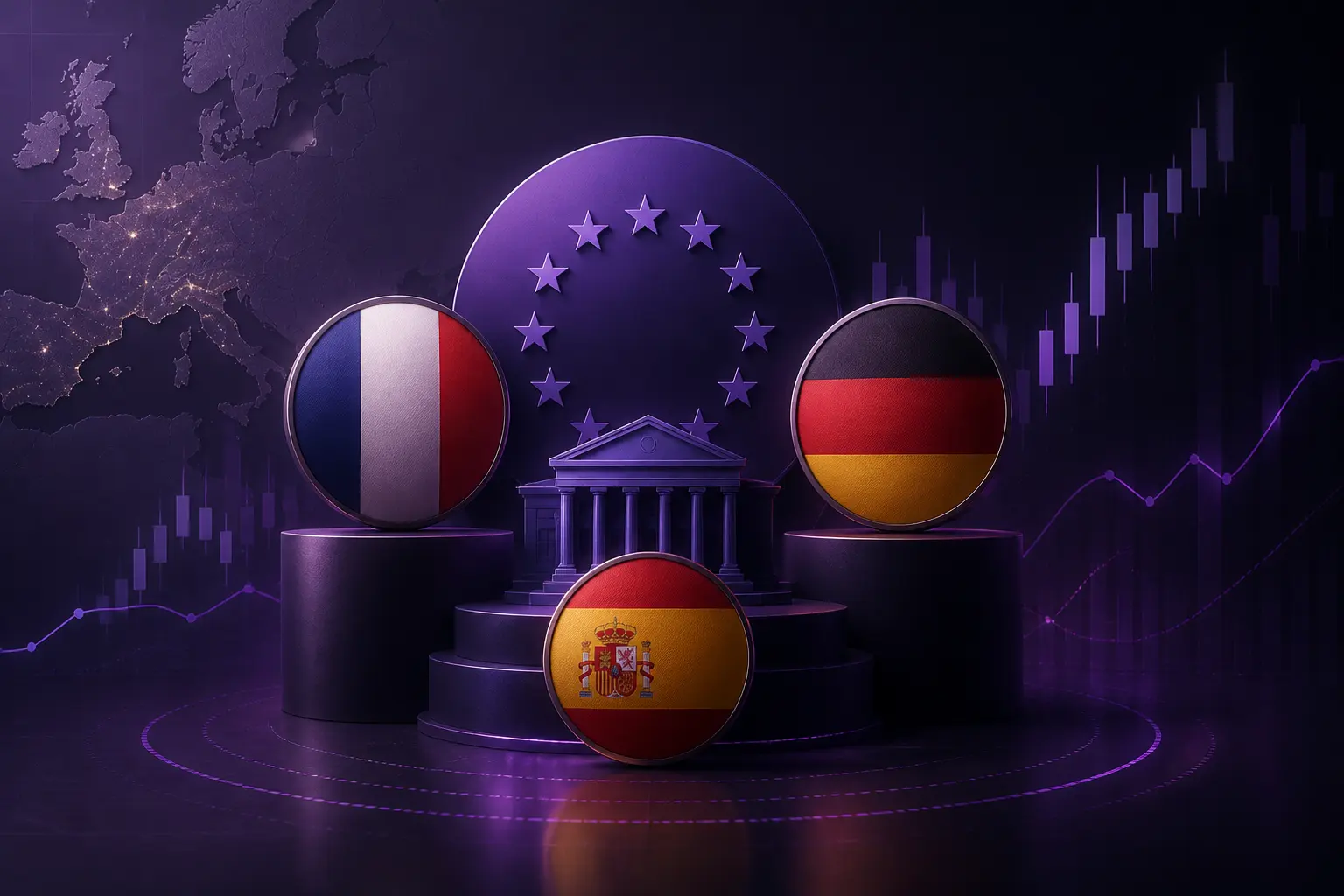
France and Germany secure senior ECB positions while Spain is poised to take the presidency, reshaping the central bank's leadership mix.
VNIX Quick Take
- France and Germany are set to fill senior European Central Bank roles, with Spain lined up for the presidency.
- The distribution of top posts could influence the internal balance of the ECB's Governing Council and Executive Board.
- Traders should watch for shifts in policy communication and voting patterns that may affect EUR/USD and euro-area yields.
France and Germany Gain Key ECB Posts as Spain Eyes the Presidency
France and Germany are positioned to take senior roles at the European Central Bank, while Spain is set to assume the presidency, according to a report. The arrangement would place three of the eurozone's largest economies in influential positions within the central bank's leadership structure.
The ECB's decision-making bodies include the Executive Board, which handles day-to-day policy implementation, and the Governing Council, which sets interest rates. The distribution of these roles among member states is closely watched because it can shape the tone and priorities of policy discussions.
While the report does not specify which exact positions each country will fill, the development signals a continued emphasis on geographic balance in the eurozone's monetary architecture. For market participants, such appointments matter because they can affect the communication style and consensus-building process at the ECB.
Why National Representation Matters at the ECB
Influence on Policy Debates
Executive Board members participate in the Governing Council's deliberations and often serve as the public face of ECB policy. A stronger presence from France and Germany could tilt the internal debate on issues such as the pace of interest-rate changes, balance-sheet policy, and the use of forward guidance.
However, ECB decisions are made collectively, and individual members typically emphasize the euro-area-wide perspective rather than national interests. Still, their backgrounds and prior policy stances can color their contributions.
Spain's Presidency and the Eurozone's Southern Flank
Spain's expected presidency would give a southern eurozone economy a prominent voice at the top of the institution. This could be relevant for debates on fiscal coordination and structural reforms, where southern member states often have distinct views.
Historically, the ECB has strived to maintain a balance between countries with different economic conditions—such as Germany's export-driven model and Spain's more services-oriented economy. The new lineup will be tested in how it navigates disagreements over inflation management and financial stability.
Market Levels and Assets to Monitor
Traders will likely focus on the euro's exchange rate, particularly EUR/USD, as a barometer of how the new leadership is perceived. Any signals of a more hawkish or dovish tilt could influence the currency pair. Additionally, euro-area government bond yields, especially German Bunds and Spanish Bonos, may react to changes in the ECB's policy stance.
Technical indicators such as moving averages and relative strength can help contextualize price action, but the fundamental driver here is the evolving composition of the ECB's leadership. Keeping an eye on key indicators like inflation prints and PMI data will also be crucial, as these shape the policy environment the new officials will inherit.
What This Means for Traders and How to Think About It
Leadership changes at central banks often have a muted immediate market impact, but they can gradually influence policy direction. Traders should avoid overinterpreting individual appointments; instead, watch for collective signals from ECB speeches and meeting minutes in the coming months.
For those looking to trade euro-related assets, it's important to consider the broader economic context: inflation trends, growth differentials, and global risk sentiment. The new appointments may affect how the ECB communicates its reaction function, which in turn could alter volatility patterns in forex markets.
Engaging with the trading community can provide additional perspectives on how others are interpreting the news. Platforms like VNIX signal rooms allow traders to share ideas and analysis, which can be valuable when assessing central bank developments.
Ultimately, this is a reminder that central bank governance is a slow-moving variable. It rarely dictates short-term price action, but it contributes to the structural backdrop for monetary policy. Traders should incorporate it into their fundamental toolkit alongside more timely data releases.
In VNIX's view
The reported allocation of ECB roles to France, Germany, and Spain reinforces the eurozone's core-periphery dynamics in monetary policy. While the immediate market impact is likely limited, the appointments could subtly influence the ECB's communication and decision-making style. Traders should monitor upcoming speeches and policy statements for hints of any shift in the ECB's reaction function, as these will be more actionable than the appointments themselves.
Educational analysis, not financial advice. Trading involves risk.
รับสัญญาณเทรดเรียลไทม์
จุดเข้า เป้าหมาย และจุดตัดขาดทุน สำหรับทองคำ คริปโต และฟอเร็กซ์ คัดสรรโดยทีมงาน